For years, social media marketing worked on a fairly simple principle. You built an audience. People followed your page. You posted content. Your followers saw it.
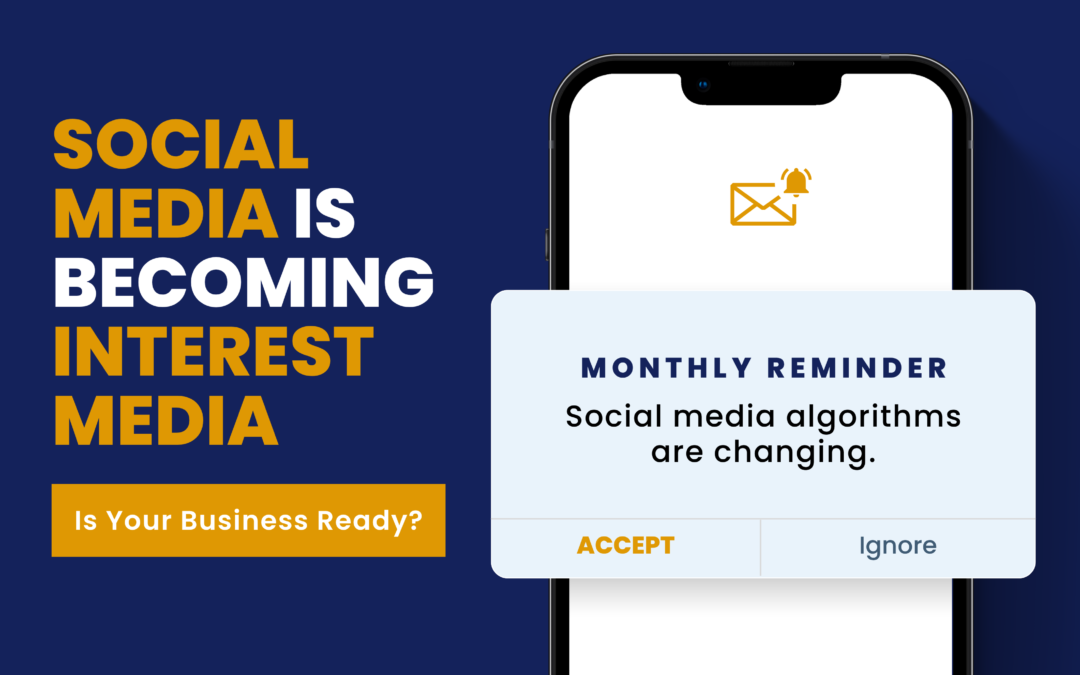
That model hasn’t disappeared completely, but it is changing. Increasingly, the content appearing in our feeds isn’t there because we follow the person or business that posted it. It is there because an algorithm has decided we might be interested in it. Social media is becoming interest media.
Traditional social media was largely built around what is sometimes called the social graph, the network of people, businesses and organisations you chose to connect with. Follow a business and you would expect to see its posts.
Today’s platforms increasingly operate around an interest graph. They are constantly learning what captures your attention.
- What do you watch?
- What do you skip?
- What do you save?
- What do you share privately?
- What do you comment on?
- What subjects do you repeatedly engage with?
- What do you search for?
- What keeps you watching?
All of these signals help platforms decide what you might want to see next.
TikTok’s For You feed is perhaps the most obvious example. TikTok explains that its recommendations consider user interactions such as likes, shares, follows and comments alongside information within the video itself, including captions, sounds and hashtags. Importantly, stronger indications of interest, such as watching a longer video all the way through can carry more weight than weaker signals.
Meta is heading firmly in the same direction. Facebook says its recommendation engine is designed to understand people’s interests faster and show them more relevant content. Meta has also continued investing heavily in AI-powered recommendations across Facebook and Instagram.
So The Question For Businesses Is Changing From:
“How do we get more followers?”
“How do we create something that the right person will actually be interested in?”
Actually, This Could Be Good News For SMEs
It is easy to look at algorithm changes negatively. Organic reach is harder. There is more content. AI has made creating content easier, which means there is even more competition for attention. However, interest media creates an opportunity too.
You don’t necessarily need tens of thousands of followers for a post to travel beyond your existing audience. If you produce something genuinely useful, entertaining, interesting or relevant to a particular group of people, platforms have an incentive to show it to more people with similar interests.
Facebook, for example, says improvements to its Feed and video ranking delivered a 7% increase in views of organic Feed and video posts in Q4 2025. It also reported that 75% of Instagram recommendations in the US were coming from original posts.
The opportunity isn’t simply to build an audience anymore. It is to earn attention. There is an important caveat, though. Don’t respond by becoming obsessed with the algorithm.
If every post is engineered for watch time, trends, keywords and engagement, your marketing can quickly stop sounding like you.
The businesses that succeed in the interest-media era will understand the algorithms without forgetting the humans those algorithms are trying to serve. So, what should you do?
10 Ways To Move From Social Media To Interest Media
(without losing the human bit)
The Algorithm Isn't Your Audience
Perhaps this is the most important thing to remember for us at Creationz is that algorithms will continue to change. Platforms will introduce new features. AI will become increasingly involved in deciding what we see. Meta is already using more AI and additional behavioural signals to personalise recommendations. Trying to “beat the algorithm” is therefore a losing game.
Instead, understand what the algorithm is trying to achieve. It wants to give people content they are likely to find relevant enough to watch, read, save, share or interact with. So create that.
Social media may be becoming interest media. But good marketing is still human.